 TAMARA MARINO
NOW
(In collaboration with Simon Troger)
Performance
Piazza Libertà - Acate (RG)
10 / 9 / 2022
Fotografia
Canson Infinity Edition Etching Rag 100% cotone
p.a. stampa a pigmento
2022
IT |
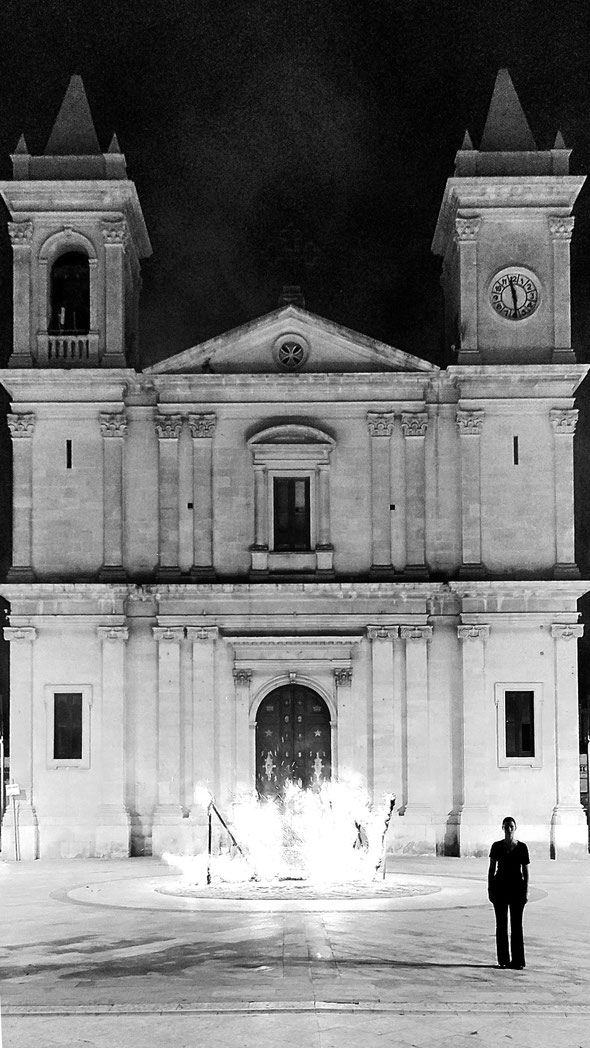
L’azione performativa, realizzata in collaborazione con Simon Troger, si svolge in Piazza Libertà ad Acate (RG), nello spazio liminale che separa e al tempo stesso connette la chiesa di San Nicolò di Bari e il Castello dei Principi di Biscari.
Questo interstizio urbano — carico di storia, fede, potere e memoria — diviene un campo di tensione simbolica in cui la materia brucia, si trasforma e si offre come scrittura effimera. L’opera mette in relazione due tradizioni rituali distanti nello spazio ma convergenti nel senso: la Vampanigghia ri Santa Lucia, rito notturno siciliano di purificazione e luce, e i Larmstangen della Val Venosta, totem lignei che portano in sé la memoria del dolore e della rinascita. Da questo intreccio nasce un gesto che non è solo azione ma traduzione tra culture, un linguaggio del fuoco che attraversa territori, lingue e appartenenze. La combustione di una superficie di paglia genera un messaggio cifrato, una scrittura che si manifesta nell’istante della distruzione. Il fuoco diventa medium e atto linguistico, e ciò che rimane — cenere, bruciature, tracce — si trasforma in archivio del gesto, in codice da decifrare secondo la posizione, la luce, il tempo e lo sguardo di chi osserva. La materia residua assume una densità concettuale: è testimonianza del passaggio, reliquia e frammento di un linguaggio che rifiuta la permanenza. La performance si muove tra sacro e profano, mito e contemporaneità, evocando una dimensione in cui la distruzione non coincide con la perdita ma con la possibilità di una nuova semiosi. Il fuoco, elemento primordiale e universale, diviene strumento di rivelazione e di dubbio, capace di dissolvere le gerarchie estetiche e religiose per aprire uno spazio comune, condiviso, dove l’identità è materia in combustione. Nel dialogo tra Sud e Nord, tra luce e cenere, tra parola e rovina, si afferma un territorio poetico e politico in cui la resistenza culturale si manifesta come pratica estetica. L’opera è un atto di fusione e di frizione, una tensione continua tra memoria e cancellazione, una domanda sulla possibilità stessa di comprendere attraverso la perdita.
EN |
The performance action, created in collaboration with Simon Troger, unfolds in Piazza Libertà, Acate (RG), within the liminal space that both separates and connects the Church of San Nicolò di Bari and the Castle of the Princes of Biscari.
This urban interstice — dense with history, faith, power, and memory — becomes a symbolic field of tension where matter burns, transforms, and offers itself as ephemeral writing. The work establishes a relationship between two ritual traditions, distant in geography yet convergent in meaning: the Sicilian Vampanigghia ri Santa Lucia, a nocturnal rite of purification and light, and the Larmstangen of Val Venosta, wooden totems that carry within them the memory of pain and rebirth. From this convergence arises a gesture that is not merely an action but a translation between cultures, a language of fire that traverses territories, tongues, and identities. The controlled burning of a straw surface generates an encrypted message, a script that emerges in the very instant of its destruction. Fire becomes both medium and linguistic act, and what remains — ashes, scorch marks, traces — transforms into an archive of the gesture, a code to be deciphered through the shifting coordinates of light, time, and gaze. The residue assumes a conceptual density: testimony of passage, relic, and fragment of a language that refuses permanence. The performance oscillates between sacred and profane, myth and contemporaneity, evoking a dimension in which destruction does not imply loss but rather the possibility of a new semiosis. Fire, as a primordial and universal element, becomes both instrument of revelation and of doubt, dissolving aesthetic and religious hierarchies to open a shared, common space where identity itself becomes a burning material. In the dialogue between South and North, between light and ash, between word and ruin, a poetic and political territory emerges — one in which cultural resistance manifests as an aesthetic practice. The work is an act of fusion and friction, a continuous tension between memory and erasure, a meditation on the possibility of understanding through disappearance.